

AI Existing-Client Call Routing: Separate Active Matters from New Legal Intake
Peak Demand builds Legal Voice AI that identifies whether a caller is contacting the firm about an active matter, a new legal need, or a request that needs staff review. The workflow can collect approved identifiers, preserve context, and route current-client calls toward the correct team without turning client service into another new-intake path.
Recognize current-client requests and keep them out of prospect-intake queues.
Preserve a separate path for prospective clients and genuinely new matters.
Legal judgment, sensitive exceptions, representation decisions, and advice stay with authorized staff.
An active client calling about an existing matter should not have to restart legal intake.
Law-firm phone traffic often mixes prospective clients, existing clients, referral partners, administrative questions, scheduling requests, status questions, document follow-up, billing calls, and sensitive issues on the same published number. Existing-client routing creates an early branch so a current matter can move toward client service rather than being treated like a brand-new inquiry.
Protect the intake queue
New-client intake stays focused on prospective matters instead of being filled with callers who already have an active file or established relationship with the firm.
Preserve client context
The workflow can capture the caller's stated matter context, requested action, preferred callback information, and other approved identifiers before routing or handoff.
Send work to the right destination
Status requests, appointment changes, billing questions, document questions, messages, and sensitive issues can follow different firm-defined routes instead of one generic transfer rule.
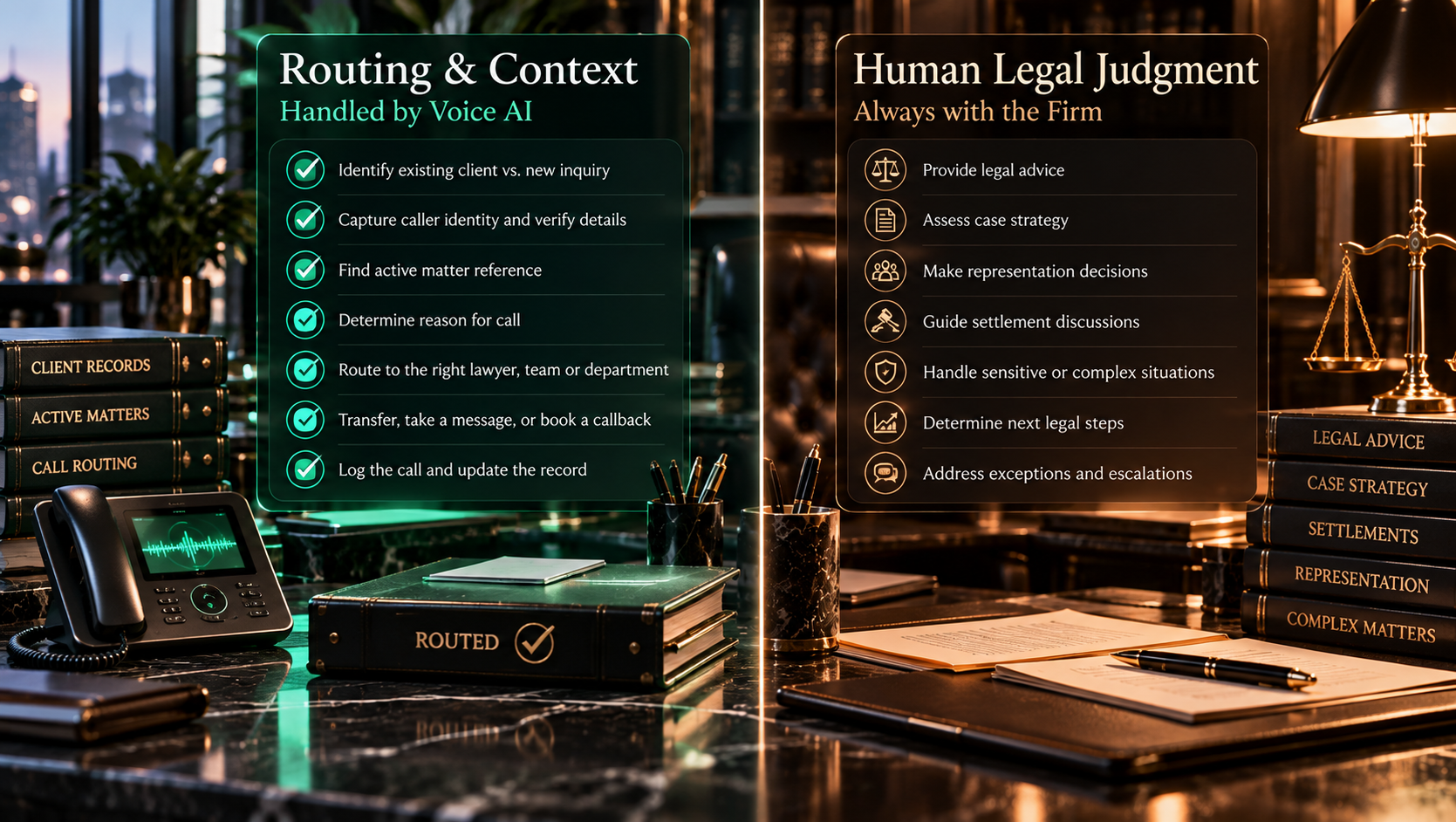
Peak Demand's role is to automate the phone workflow around identification, structured intake, routing, confirmations, and handoff. The system does not decide what legal advice to give, whether the firm represents a caller, what a case is worth, or how a matter should be handled.
The first job is to understand what relationship the caller has with the firm.
A useful existing-client workflow does not blindly assume every caller is a new lead or every returning caller belongs to a current matter. It asks only the approved questions needed to place the call into the correct operational lane, then preserves uncertainty when the answer is not clear.
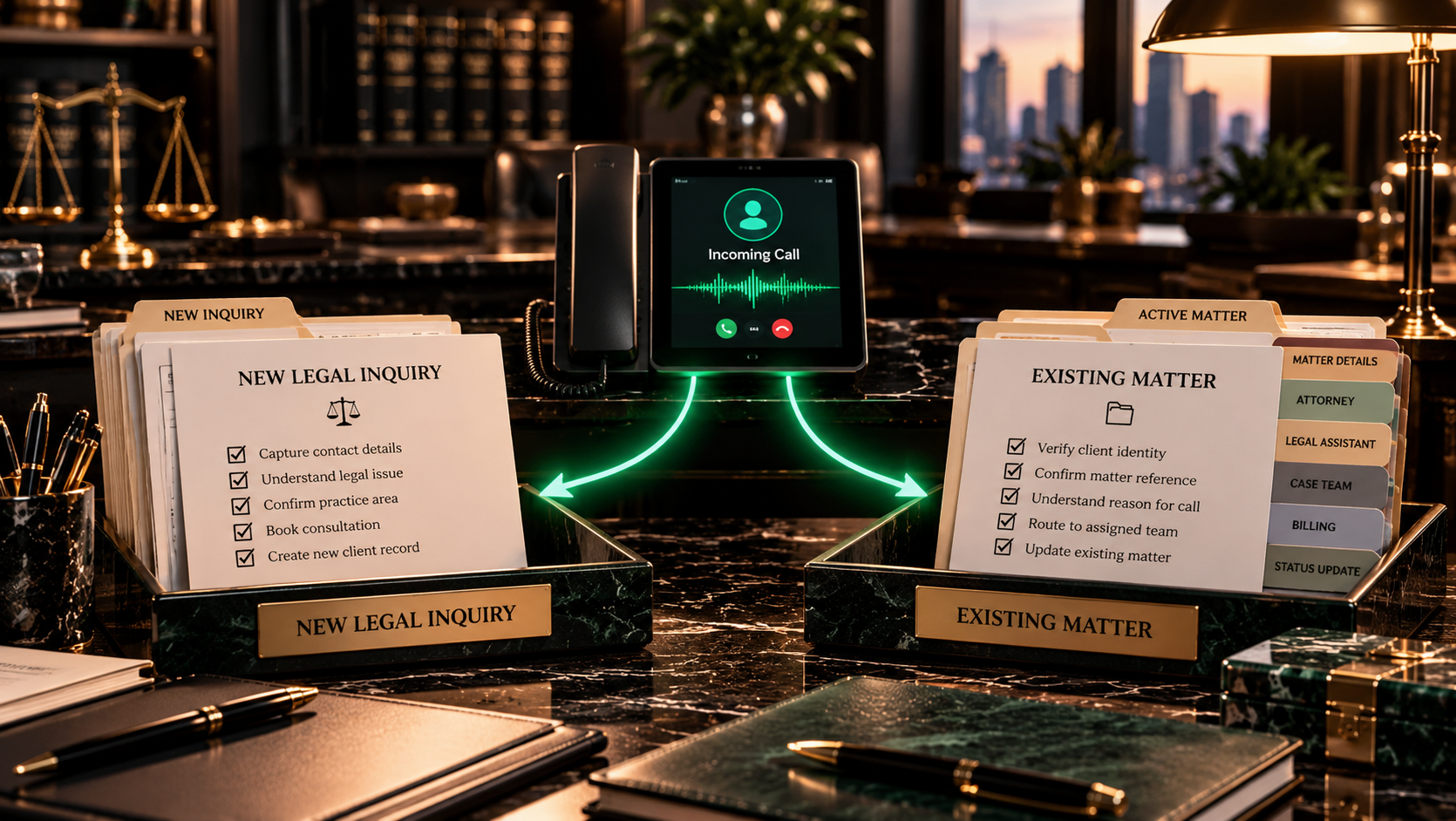
Answer. Identify. Understand the request. Route with context.
The exact questions and destinations vary by law firm, but the architecture can follow a controlled sequence that distinguishes active-client service from new intake while keeping ambiguous and sensitive calls inside human-defined boundaries.
01 · Answer
Receive the call with the firm's approved greeting and determine the caller's reason for contacting the office.
02 · Establish relationship
Ask whether the call concerns an existing matter, a previous relationship, or a new legal issue, using only the identifiers the firm approves.
03 · Capture request
Collect the operational context needed for routing, such as matter type, requested staff member, appointment need, billing question, message, document issue, or status request.
04 · Route or hand off
Transfer, schedule a callback, create a structured note, notify the right queue, or escalate to human review according to the firm's business rules.
Not every active-client call belongs with the same staff member or practice group.
The purpose of routing is not merely to determine that a caller is an existing client. It is to understand the operational request well enough to send it toward the right destination without the Voice AI making legal decisions.
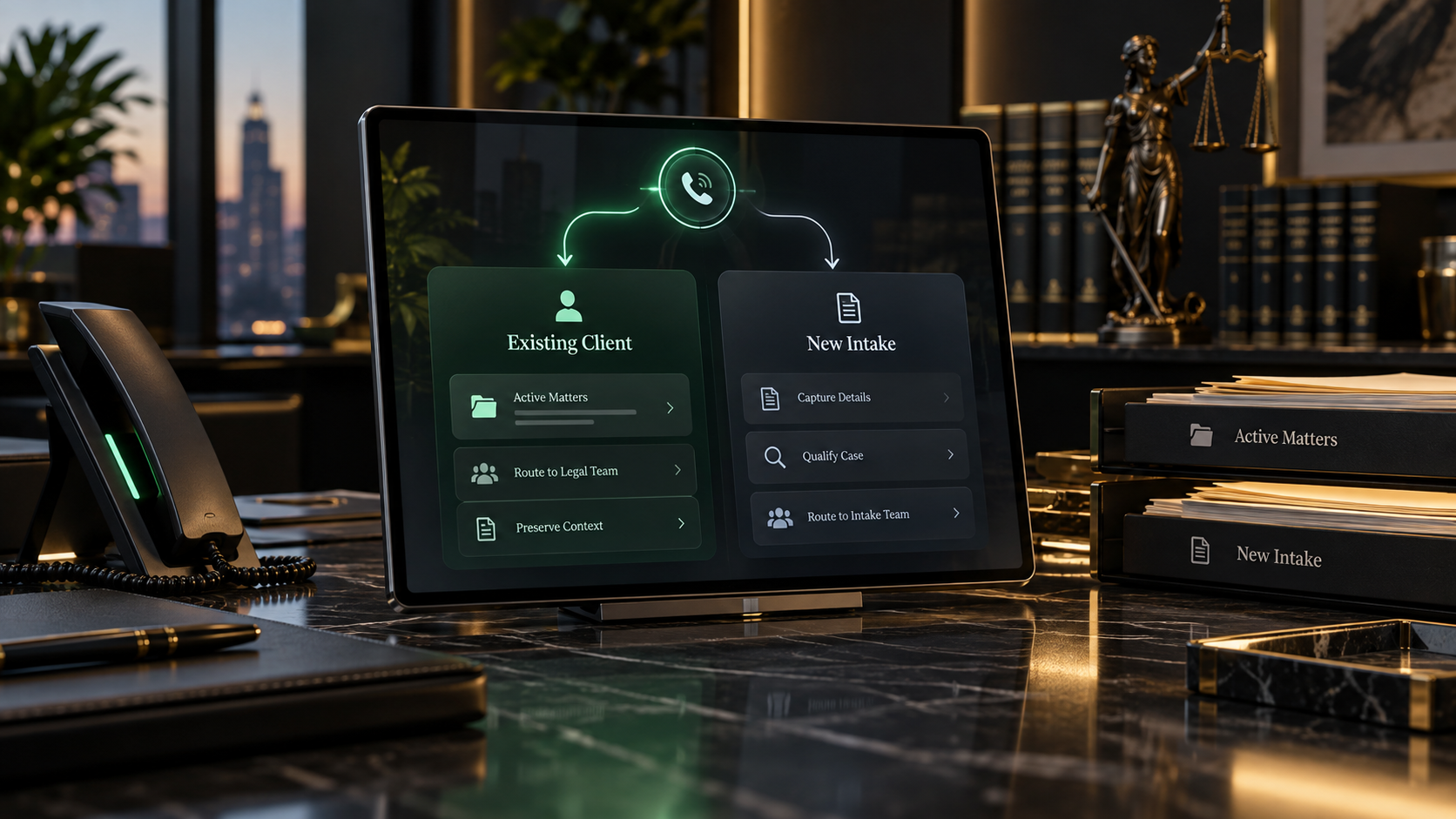
Matter-status requests
Capture that the caller is asking for an update and route the request to the appropriate lawyer, assistant, case team, callback queue, or approved status workflow. The AI should not invent a case update.
Scheduling and appointment changes
Route requests to book, move, cancel, or confirm appointments according to connected calendar permissions and the firm's scheduling rules.
Billing and payment questions
Separate administrative billing traffic from legal intake and direct it to the designated billing, accounts, receptionist, or staff-review destination.
Documents and messages
Capture the caller's stated reason for sending, requesting, or discussing a document and preserve the message for the correct legal or administrative contact.
Lawyer or staff callbacks
Collect a callback request, preferred contact details, matter context, and approved availability information so staff can follow up with less reconstruction.
Sensitive or unusual issues
Complaints, urgent developments, uncertainty, legal-advice requests, conflict-sensitive information, or anything outside the approved workflow can be moved to human review.
Routing can be automated. Legal judgment cannot be delegated to the call flow.
Existing clients may ask questions that sound operational but carry legal significance. The workflow needs explicit boundaries so it can collect and route information without accidentally presenting an automated response as legal advice, case strategy, a promise, or an authoritative matter update.
The destination should not have to ask the caller to start over.
Routing becomes more useful when the Voice AI passes along the approved context it has already collected. That can mean a structured transfer note, callback request, notification, CRM entry, matter-system field update, or other connected action supported by the firm's systems and permissions.
Live transfer
When staff are available and the telephony setup supports it, the system can transfer the caller to a designated destination and preserve the reason for the call.
Structured callback
If the destination is unavailable, capture callback details, preferred timing, matter context, and the caller's requested outcome for staff follow-up.
Review queue
When the correct destination is uncertain or the call crosses a sensitive boundary, route the summary into a human-review workflow rather than guessing.
The routing logic can sit between the phone conversation and the firm's operational systems.
Peak Demand can design a deterministic logic layer around the firm's approved rules: what questions to ask, what counts as an existing-client path, which identifiers are required, when a route is allowed, which destination is selected, what context is written back, and what happens when data or integrations are unavailable.
Telephony
Inbound numbers, business-hours rules, overflow logic, transfer destinations, after-hours behavior, caller identification, and fallback paths can be coordinated around the existing phone environment.
CRM / matter systems
Where documented API access and permissions are available, routing may reference or update approved contact, matter, task, note, callback, or workflow data instead of operating as an isolated receptionist.
Notifications and staff actions
Email, SMS, task queues, internal notifications, callback requests, structured summaries, and other approved actions can be triggered after the call or at key workflow branches.
If a system does not expose usable data, permissions, or API operability, the Voice AI should not pretend it knows the caller's matter status. The safe fallback is capture, route, and human review.
The split between new intake and client service should reflect how the firm actually operates.
A multi-practice firm may need different verification, routing, hours, fallback, office, language, or staff rules than a boutique practice. Peak Demand builds the workflow around those client-specific decisions rather than forcing every firm into the same preconfigured receptionist path.
Define the relationship rules
Decide how the system distinguishes a new prospect, current client, former client, referral partner, family member, third party, or caller whose relationship cannot be verified.
Define the client-service branches
Map matter-status requests, scheduling, billing, documents, callbacks, complaints, staff messages, urgent developments, and other common active-client call types.
Define the destinations and fallbacks
Specify lawyers, assistants, practice groups, offices, billing, reception, callback queues, after-hours contacts, review queues, and what happens if a route cannot complete.
Connect existing-client routing to intake, summaries, handoff, and specialized service workflows.
Legal Intake Automation
Keep prospective-client intake on a dedicated path with structured questions, qualification, scheduling, routing, and review.
AI Call Summaries
Generate structured phone notes so lawyers and staff receive useful caller context for follow-up.
Human Handoff
Move sensitive, uncertain, urgent, or review-required calls to authorized staff with the intake context already collected.
Matter-Status Routing
Route existing-client update requests toward the correct team without inventing or interpreting legal status information.
Questions law firms ask about separating active matters from new legal intake.
These answers focus on caller identification, active-matter routing, new-matter exceptions, status requests, scheduling, billing, staff handoff, integrations, privacy, and the legal decisions that remain human-controlled.
What is AI existing-client call routing for law firms?
Why separate existing-client calls from new legal intake?
How can the AI tell whether someone is an existing client?
Can an existing client still be calling about a new legal matter?
Can the AI identify a specific lawyer or legal assistant?
Can it route matter-status calls?
Will the AI tell clients the status of their case?
Can it handle consultation or appointment changes for current clients?
Can billing and payment questions be routed separately?
Can existing clients leave a message for their lawyer?
Can the AI transfer an existing client live?
What happens if the correct staff member is unavailable?
Can the AI create a callback request?
Can it recognize urgent existing-client calls?
Can it handle complaints from existing clients?
Can it route document questions?
Can the routing use a CRM or case-management system?
What if the firm's software cannot be integrated?
Can the AI access confidential matter information?
Does the AI decide whether the firm represents the caller?
Can it conduct conflict checks for a new issue raised by an existing client?
Can it provide legal advice to existing clients?
Can different practice groups have different existing-client routes?
Can Peak Demand build a custom new-client versus existing-client workflow?
Where should a law firm start?
Separate active matters from new intake without losing caller context.
Peak Demand can map how your firm identifies current clients, handles new issues from existing relationships, routes matter requests, captures callbacks, handles unavailable destinations, and escalates the calls that should remain human-controlled.
Top existing-client call reasons, matter-identification rules, current routing destinations, business-hours and after-hours coverage, callback expectations, sensitive-call escalation rules, and the systems staff use to manage active matters.