

Custom Conflict-Check Pre-Intake: Capture Parties & Names for Firm Review
Before a law firm can decide whether to move forward, it needs to know who may be involved. Peak Demand builds custom Voice AI that records names, entities, stated relationships and uncertainty, then routes a structured pre-check record to the firm. Conflict decisions stay with authorized legal staff.
A promising new inquiry is not the same thing as an intake the firm can accept.
A prospective client may call with a straightforward request, yet the relevant participants may include a spouse, former employer, affiliated company, co-owner, estate, insurer or opposing party. The firm needs an orderly way to identify the relevant names before substantive conversation begins.
Custom conflict-check pre-intake is intentionally narrower than a legal consultation. It captures a limited set of firm-approved identifiers, confirms what can be confirmed, records what remains uncertain, and queues the request for review. It does not decide whether a professional conflict exists.
Providing names for a preliminary review does not establish a lawyer-client relationship, mean the firm has agreed to act, or authorize the caller to disclose confidential facts.
Capture the identities the firm needs, in the form the firm needs them.
Every practice has different name-search requirements. The following are configurable categories, not a universal checklist or a request to collect everything from every caller.
Prospective client
Record the caller's name, the proposed client's name if different, and any firm-approved identifier needed to distinguish the record.
Other parties
Capture the names the caller knows for counterparties, opposing parties or other participants relevant to the preliminary review.
Businesses and entities
Distinguish registered names, trade names, company suffixes, partnerships, trusts or estates when the firm needs those distinctions.
Former names and aliases
Ask about additional names only where the firm has approved the question and it is relevant to the proposed matter.
Stated relationships
Capture whether a named individual is an owner, director, spouse, employer, representative or another role, without making legal assumptions.
Known unknowns
Mark missing names, uncertain spellings and unverified relationships so staff can see exactly what still needs confirmation.

One caller conversation. One usable record for the firm's next decision.
A well-defined path avoids jumping prematurely into the merits of a matter while ensuring that a caller is not asked to repeat the same names to multiple staff members.
When everything needed is available
The Voice AI packages the names and role labels, records the call's outcome and submits the request to the authorized team. It does not declare the firm cleared.
When a required field is unresolved
The request stays visibly incomplete and follows a client-defined callback, staff-review or alternate pathway. Missing data is never silently filled in.
Names matter. The relationships between names matter too.
A caller may name an employer, a parent corporation and a manager as if they were interchangeable. Another caller may give only a trade name. A useful pre-check record preserves these distinctions rather than flattening them into one unstructured note.
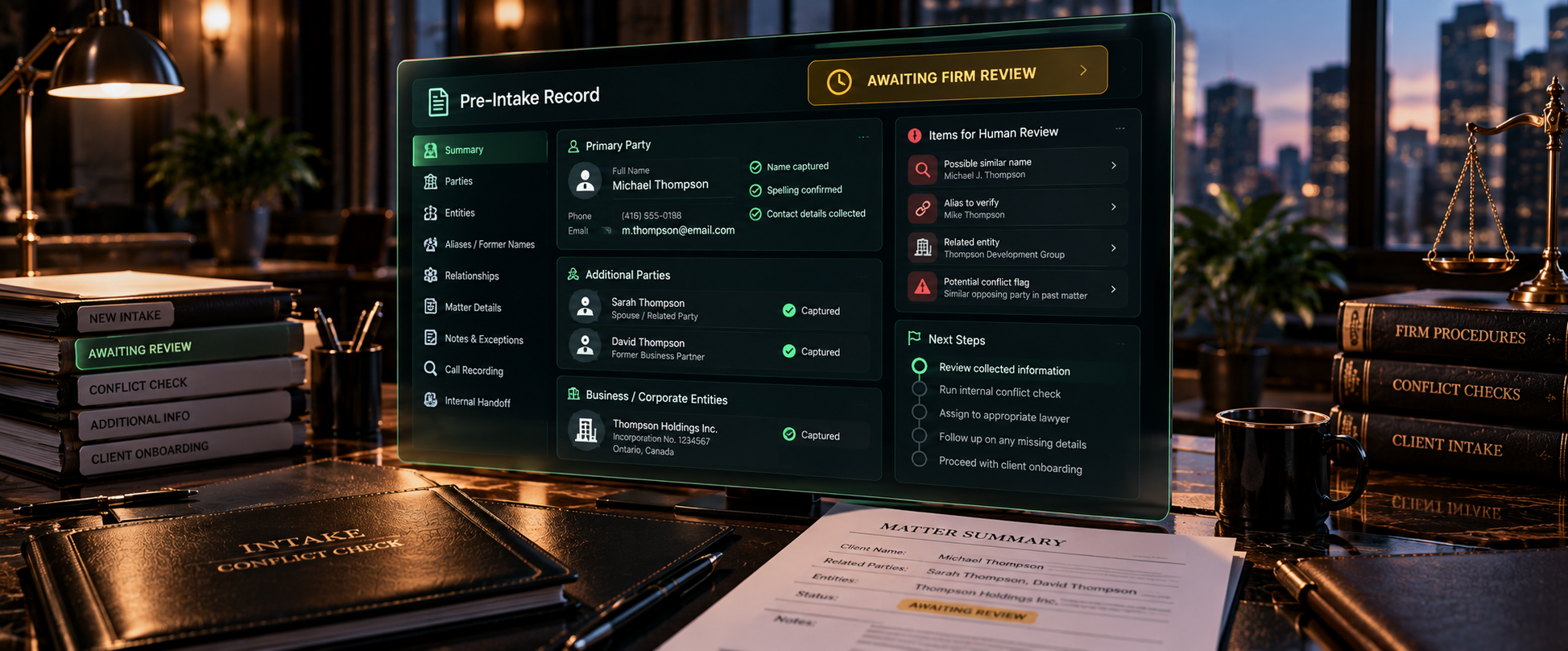
Peak Demand can configure explicit fields for each participant's stated role, alternate legal or operating names, and the source of the information. Those labels help reviewers ask the right follow-up questions; they do not imply that any relationship has been verified.
A prospective client names a property-management company, its operating brand and an individual contact. The workflow records three distinct entries and the caller's stated connection between them, flagging uncertainty for the firm to resolve.

Automate the organized questions. Never automate a representation decision.
The agent's purpose is to help staff receive consistent preliminary information. The firm sets the permitted questions, disclosure language, storage rules and escalation thresholds.
- Ask for approved party and entity names
- Confirm spelling and relevant business suffixes
- Record whether a relationship is stated or uncertain
- Flag duplicate-looking or missing entries for follow-up
- Create an access-controlled, staff-ready review request
- Determining whether a conflict exists
- Deciding whether to proceed, decline or seek a waiver
- Professional confidentiality and consent obligations
- Approving any substantive legal intake or consultation
- Confirming representation and engagement terms
Where appropriate, the agent can explain that detailed allegations, documents and other potentially confidential material should be withheld until the firm directs the caller to the correct next step.
The right pre-check is specific to the practice, the office and the review team.
Litigation, family, corporate, real estate and employment inquiries may involve different participants and naming conventions. Peak Demand designs the conversational logic and deterministic guardrails around the firm's approved questions, disclosures, queues and escalation conditions.
Where an approved integration is feasible, structured fields can feed the firm's existing intake or review process. Where it is not, the workflow can produce a staff-ready summary for manual screening. Any system search result remains subject to firm review.
Define the rules, not just the script
Practice-area branching, question order, spelling readbacks, restricted topics, office routing, review ownership, exception flags, secure handling and permissioned integrations are all controlled design inputs.
A useful pre-check record tells staff what was provided—and what was not.
The handoff should not simply say “conflict check requested.” It can identify the prospective client, captured parties and organizations, each participant's stated role, uncertain spellings, unresolved questions, practice-area queue, timestamp and recommended next internal step.
Access restrictions, retention periods, appropriate notices and downstream system behavior should follow the firm's policies and applicable requirements. The Voice AI must not imply that an internal review has taken place merely because a record has been delivered.
Design for the messy calls, not only the clean examples.
The caller only knows a nickname
Capture the nickname as reported, ask the limited clarification permitted by the firm and flag the formal name as unknown.
Several companies share a brand
Record each named entity separately and avoid treating a shared logo, trade name or address as proof of legal identity.
The caller starts telling the full story
Use the agreed interruption language to redirect the conversation to identity capture, with a human pathway for sensitive situations.
Questions firms ask before collecting party names by Voice AI.
These answers distinguish preliminary name capture from a conflict determination, legal advice, acceptance or engagement.
What is conflict-check pre-intake for a law firm?
Can Voice AI decide whether a conflict exists?
Which names should be collected?
Why does spelling verification matter?
Can the AI ask for details of the legal problem?
What if a caller does not know the opposing party?
Can it capture corporations and individuals in the same call?
What happens when two callers share the same name?
Does a submitted pre-intake form mean the firm is representing the caller?
Can the workflow support multiple practice areas?
Can the AI collect information after business hours?
Can the system check against the firm’s existing database?
What if a caller reveals confidential information anyway?
Can it serve more than one office or jurisdiction?
What should the firm provide before a custom build?
How is pre-intake different from full legal intake?
Build a clearer first step before substantive legal intake.
Peak Demand can map your name-capture requirements, conflict-review ownership, practice-area exceptions, confidentiality boundaries and existing tools into a controlled Voice AI pre-intake flow.
Approved party fields, practice-area differences, naming conventions, disclosure language, review queues, who handles uncertain matches, retention rules and integration requirements.